
Introduction
Choosing between a cleaning service vs a maid is a decision that shapes how daily routines, privacy, financial commitments, and a home function over time.
While both options are often discussed interchangeably, they operate on fundamentally different models of support. Understanding these differences helps households avoid mismatched expectations that lead to frustration or unnecessary long-term obligations.
Why “Cleaning Service vs Maid” Is Not a Like-for-Like Comparison
At first glance, the decision appears to be a simple choice between two ways of keeping a home clean. In reality, these options are built on entirely different foundations.
A cleaning service is outcome-driven. It is designed to complete specific tasks within a fixed timeframe using a structured, professional approach. A live-in maid is presence-driven. The role extends beyond cleaning and adapts to the household’s daily rhythm.
This distinction is important because many households approach the choice as a simple, direct comparison of cost or convenience.
When the underlying models are misunderstood, expectations become misaligned.
Framing the decision correctly from the start helps households evaluate each option based on how it actually functions, rather than assuming both serve the same purpose in different forms.
This article breaks down what each option truly offers, where they overlap, and how to decide which arrangement aligns with how your home is actually lived in.
Key Takeaways
- The cleaning service vs maid decision hinges on structure versus presence, not just cost.
- Cleaning services deliver task-based, professional results within fixed timeframes.
- Live-in maids provide continuous support but come with employment obligations and lifestyle adjustments.
- Privacy, flexibility, and long-term commitment often outweigh price comparisons.
- The right choice aligns with real living patterns, not assumptions about convenience.

Understanding Cleaning Service vs Maid
What Is a Cleaning Service
A cleaning service typically refers to a professional agency that provides trained cleaners on a scheduled or task-based basis.
Cleaning sessions are carried out within a fixed timeframe and focus on specific outcomes such as floor care, bathroom sanitation, kitchen cleaning, and general housekeeping.
Cleaners are deployed and managed by a company, which means training standards, supervision, and replacements are handled externally. This reduces the need for households to manage staffing concerns directly.
The arrangement is designed for clarity and consistency, where tasks are agreed upon in advance and delivered systematically.
Many households rely on cleaning services in Singapore for routine upkeep, particularly when flexibility is a priority.
What a Cleaning Service Is Not Designed to Provide
A cleaning service is not intended to function as continuous household support or on-demand assistance throughout the day. It does not replace caregiving, childcare, or cooking.
In a broader discussion comparing the two services, this distinction is critical.
Cleaning services operate within defined scopes, which means cleaners are not expected to remain on standby or adapt informally.
When households require presence-based support, this model may feel limiting, even though it is performing exactly as designed.
What Is a Live-in Maid
A live-in maid is directly employed by the household and resides within the home.
This arrangement is centred on availability rather than on a consistent structure.
Responsibilities typically extend beyond cleaning and may include cooking, caregiving, or general household assistance.
Because the maid lives in the home, support is continuous and adaptable.
Tasks can shift throughout the day in response to immediate needs, making this model suitable for households that require ongoing attention.
However, this flexibility comes with regulated obligations.
Households must manage contracts, living arrangements, daily supervision, and welfare considerations.
What a Live-in Maid Is Not Intended to Replace
A live-in maid is not a substitute for professional cleaning systems or specialised services. In the context of cleaning service vs maid, continuous presence does not guarantee systematic or deep cleaning outcomes.
Cleaning may be interwoven with other responsibilities, which can affect consistency. Without a clear structure and expectations, tasks may become uneven or reactive rather than planned. This highlights a key distinction in the comparison of the two services.
Where Cleaning Service and Maid Overlap
At a surface level, the comparison between a cleaning service and a maid can seem straightforward because both contribute to household cleanliness.
Tasks such as mopping, wiping surfaces, and maintaining hygiene standards often overlap.
Both arrangements also require trust.
Households provide access to your home and belongings, which introduces considerations around reliability, communication, and comfort. These shared elements are why many households initially view the two options as interchangeable.
However, similarities in tasks do not translate to identical experiences. The way support is delivered, managed, and sustained differs significantly between the two.
Key Differences Between Cleaning Service vs Maid
The distinction lies in how support is structured and experienced daily.
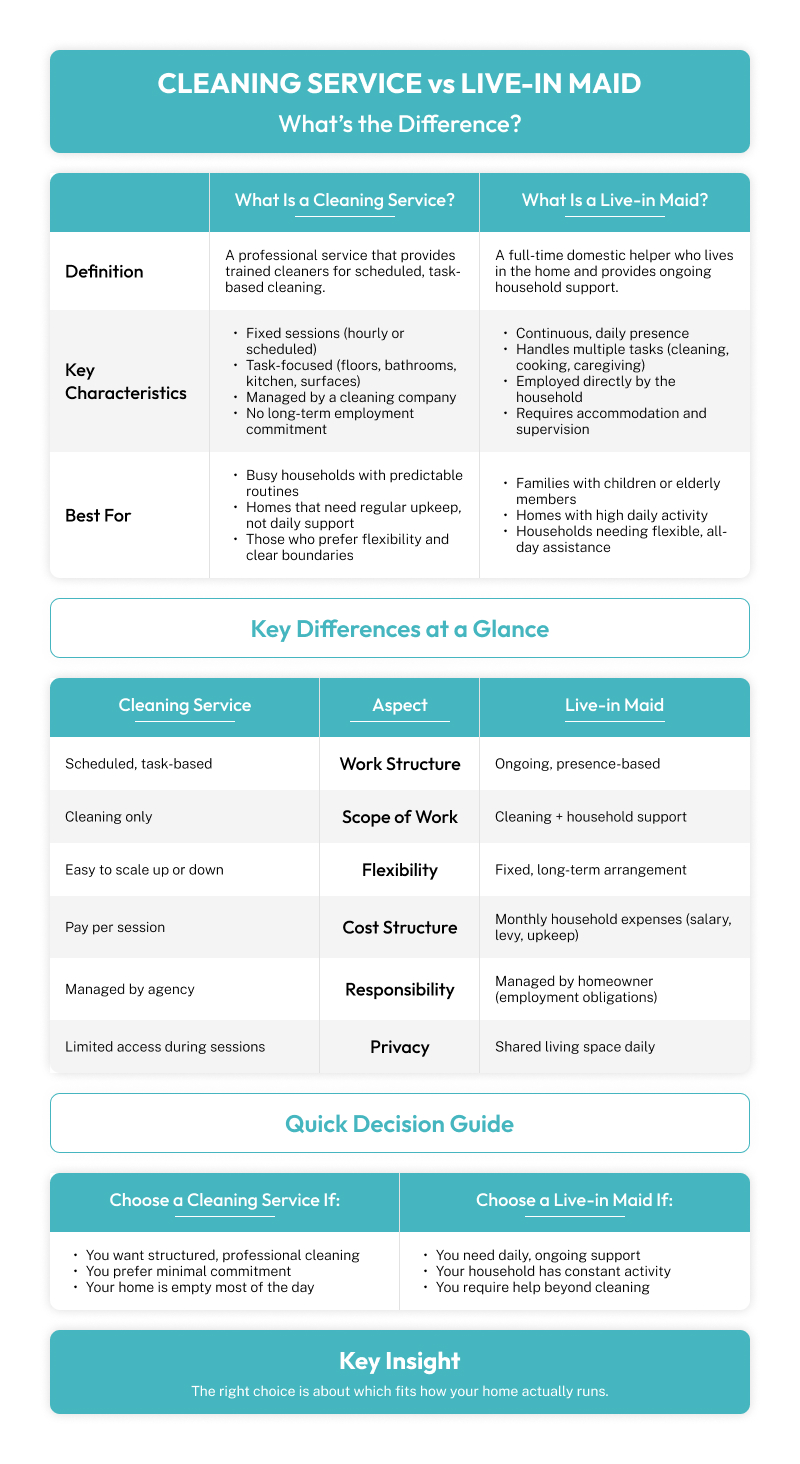
A cleaning service is built around defined tasks, fixed durations, and measurable outcomes. Each session is planned, executed, and completed within a clear scope.
A live-in maid, by contrast, is structured around presence. Tasks evolve throughout the day, often blending cleaning with other responsibilities.
This difference affects multiple aspects of home life. Household privacy concerns become more prominent with live-in arrangements, while cleaning services maintain clearer boundaries through limited access periods.
Cost is also structured differently. Cleaning services offer predictable pricing tied to sessions, while live-in maids involve broader monthly household expenses that extend beyond salary to include accommodation and daily upkeep.
Understanding these contrasts is central to making sense of the comparison.
Key Considerations Before You Hire
Level of Commitment and Responsibility
One of the most defining aspects of the decision is the level of responsibility a household is prepared to take on.
Cleaning services operate on flexible arrangements that can be adjusted or discontinued with relative ease. The agency manages staffing continuity, reducing the burden on the household.
Hiring a live-in maid introduces long-term employment obligations. This includes contracts, supervision, and responsibility for the maid’s well-being. In Singapore, households must also comply with requirements set by the Ministry of Manpower, such as adhering to these Work Permit conditions; providing suitable accommodation, ensuring rest days, and meeting ongoing welfare standards.
Over time, these responsibilities become a central part of the household dynamic, extending beyond cleaning into structured employment management.
Privacy, Boundaries, and Living Comfort
Privacy is also often the deciding factor when comparing the two.
A live-in maid shares the home environment daily, which directly affects routines, space usage, and personal comfort. This can be particularly noticeable in smaller Singapore homes where space is limited.
Cleaning services, on the other hand, operate within defined time windows. This allows households to maintain a clearer separation between personal life and external support, reducing household privacy concerns.
Cost Structure and Flexibility Over Time
Cost comparisons in the cleaning service vs maid discussion must go beyond surface figures.
Cleaning services offer transparent pricing based on hours or sessions, making costs predictable and scalable. This is especially useful for households with changing needs.
Live-in maids involve broader monthly expenses, including salary, levies, food, and accommodation. While this may be efficient for households requiring constant support, it can become inefficient if daily assistance is not fully utilised.
Flexibility is often an advantage for cleaning services, particularly for households anticipating lifestyle changes.
Choosing Based on Real Living Patterns
Homes With Predictable, Low-Disruption Routines
In homes with stable routines, the cleaning service vs maid decision often leans towards structured support.
Dual-income households that are away for most of the day typically experience gradual build-up of dust and dirt rather than constant mess. In these cases, a scheduled cleaning service provides efficient upkeep without unnecessary daily presence.
Live-in arrangements may feel excessive here, as continuous availability does not significantly improve outcomes.
Homes With High Daytime Activity or Care Needs
For households with constant activity, the cleaning service vs maid comparison shifts.
Families with young children or elderly members often require support throughout the day. Cleaning is not a single task but part of ongoing daily living.
A live-in maid becomes more suitable in these situations, as tasks can be handled in real time. Structured cleaning sessions may struggle to keep pace with continuous activity.
Homes With Transitional or Irregular Needs
Some households experience fluctuating needs. Renovations, relocation, or temporary lifestyle changes can all affect cleaning demands.
In the cleaning service vs maid decision, flexibility is the key factor here.
Cleaning services can be scaled up or down easily, making them ideal for temporary phases.
Live-in arrangements may only make sense if the need for support is expected to remain long term.
Managing Expectations: What Households Often Get Wrong
In many cleaning service vs maid decisions, dissatisfaction does not come from the option itself, but from mismatched expectations.
One common misunderstanding is assuming that more time spent in the home automatically leads to better cleanliness. In reality, outcomes depend on how tasks are structured and prioritised. A live-in maid may be present all day, but if responsibilities are split across caregiving, cooking, and errands, cleaning may become reactive rather than systematic.
On the other hand, some households expect cleaning services to adapt fluidly to changing needs during a session. This can lead to frustration when cleaners adhere to predefined scopes. In the cleaning service vs maid comparison, the difference lies in how work is organised, not just how much time is spent.
Clarity is essential. Households that define expectations early, whether in terms of task scope or daily responsibilities, tend to experience more consistent outcomes regardless of which option they choose.
Long-Term Sustainability: Which Option Holds Up Over Time
The cleaning service vs maid decision is not just about immediate convenience. It also affects how sustainable the arrangement remains over months or years.
Cleaning services are designed to adapt. Sessions can be increased during busy periods and reduced when routines stabilise. This flexibility supports changing lifestyles without locking households into fixed commitments.
A live-in maid, however, requires ongoing engagement. Over time, regulated obligations, interpersonal dynamics, and evolving expectations can influence how effective the arrangement remains. While this model works well for households with consistent, long-term needs, it may become less efficient if those needs change.
Sustainability also extends to household dynamics. Living arrangements, access to home and belongings, and daily interaction patterns all shape whether support feels seamless or intrusive.
In a broader comparison, the most sustainable choice is often the one that fits naturally as routines evolve, rather than one that feels optimal only at the start.
A Simple Workflow to Decide: Cleaning Service vs Maid
The cleaning service vs maid decision becomes clearer when broken into a practical sequence. Instead of comparing features in isolation, this workflow helps translate your daily life into a suitable form of support.
Step 1: Identify What You Actually Need Help With
Start by listing your real needs, not assumed ones.
If your priority is maintaining cleanliness through structured tasks such as mopping, bathroom cleaning, and surface wiping, a cleaning service is often sufficient.
If your needs extend to cooking, caregiving, or ongoing assistance throughout the day, the decision begins to lean towards a live-in arrangement.
Step 2: Assess How Often Support Is Needed
Frequency matters more than intensity.
Homes that require periodic resets benefit from scheduled sessions like a weekly house cleaning service.
Homes with constant activity or care responsibilities may require continuous support, which shifts the
cleaning service vs maid balance towards a live-in maid.
Step 3: Consider Your Comfort With Shared Living Space
Evaluate your tolerance for shared environments.
A live-in maid involves daily interaction and full access to your private spaces, which may raise household privacy concerns depending on your living space.
If you prefer clear boundaries and limited access windows, a cleaning service offers a more contained arrangement than a maid service.
Step 4: Evaluate Your Willingness to Manage Employment
This is often overlooked. Hiring a live-in maid comes with obligations, including supervision, welfare, and long-term responsibility.
A cleaning service removes this layer entirely, as the cleaning company manages staffing and continuity.
Step 5: Compare Long-Term Cost Efficiency
Look beyond immediate affordability.
Cleaning services provide flexible, session-based pricing that can scale with your needs. Options like hourly cleaning services allow for controlled spending.
A live-in maid involves fixed household expenses, which are only cost-effective if daily support is consistently utilised.
Step 6: Decide Based on Lifestyle Fit, Not Assumptions
The final step is to evaluate alignment.
Choose the option that fits how your home actually operates, not what seems more comprehensive on paper.
If your household values structure, flexibility, and defined outcomes, a cleaning service is likely the better fit.
If your home requires ongoing, adaptable support throughout the day, a live-in maid may be more suitable.
This workflow simplifies the decision-making into actionable steps, helping you choose a solution that remains practical and sustainable over time.
Frequently Asked Questions
Is a cleaning service enough for daily household needs?
Yes, for households where the primary need is maintaining cleanliness rather than continuous assistance. In the cleaning service vs maid comparison, structured cleaning is often sufficient for predictable routines.
Does a live-in maid always provide better value?
No. Value depends on usage. If continuous support is not required, the broader monthly household expenses may outweigh the benefits in a cleaning service vs maid evaluation.
Which option offers better consistency?
Cleaning services offer process-driven consistency, while live-in maids provide familiarity through daily presence. The better option depends on expectations within the cleaning service vs maid decision.
Can households switch between the two options?
Yes. Many households revisit their choice as their needs evolve over time.
Making the Right Choice for Your Home
The cleaning service vs maid decision should be guided by how a household functions in reality, not by assumptions about convenience or cost. Each option serves a distinct purpose, and both can work well when aligned with lifestyle, space, and expectations.
G Journey offers professional cleaning services designed around real living patterns. Rather than fixed packages, we focus on structured, flexible support that adapts to how your home is used.
Contact us today if you are weighing between engaging a cleaning service or a domestic helper.
We can discuss your household needs and recommend a practical, sustainable option once we have a clearer understanding of your routines.